
Blog
Ebikes In Kansas: What You Need To Ride The Electric Bicycle
Can you get a ticket for riding your new e-bike to work in Topeka? Usually not. Kansas treats a legal e-bike as a bicycle, so you need no driver’s license, registration, or insurance. Trouble starts when a bike falls outside the legal definition, or when you ride into a city, park, or trail with its own rules. This guide covers the state baseline first, then the local exceptions that catch riders off guard.
Key Takeaways
- A legal Kansas e-bike has working pedals, a motor under 750 watts, and fits Class 1, 2, or 3.
- Legal e-bikes need no driver’s license, title, plate, registration, or insurance.
- Nobody under 16 may operate a Class 3 e-bike. Class 1 and Class 2 have no state minimum age.
- Kansas has no statewide helmet law, but Kansas City, Missouri and several Johnson County cities require helmets under 18.
- State park trails allow Class 1 and Class 2 only, and national grasslands limit e-bikes to motorized routes.
- Changing a motor’s speed or engagement without replacing the class label is illegal.
Table of Contents
Comparing ebikes for sale in Kansas? Match the class to where you ride: Class 1 and 2 keep the widest trail and state park access, while Class 3 buys road speed and loses paths. Ebike Plugs can confirm a model’s class label and rated wattage before you buy, with in-house financing from $800 down, no credit check, and no interest.


Ebikes In Kansas
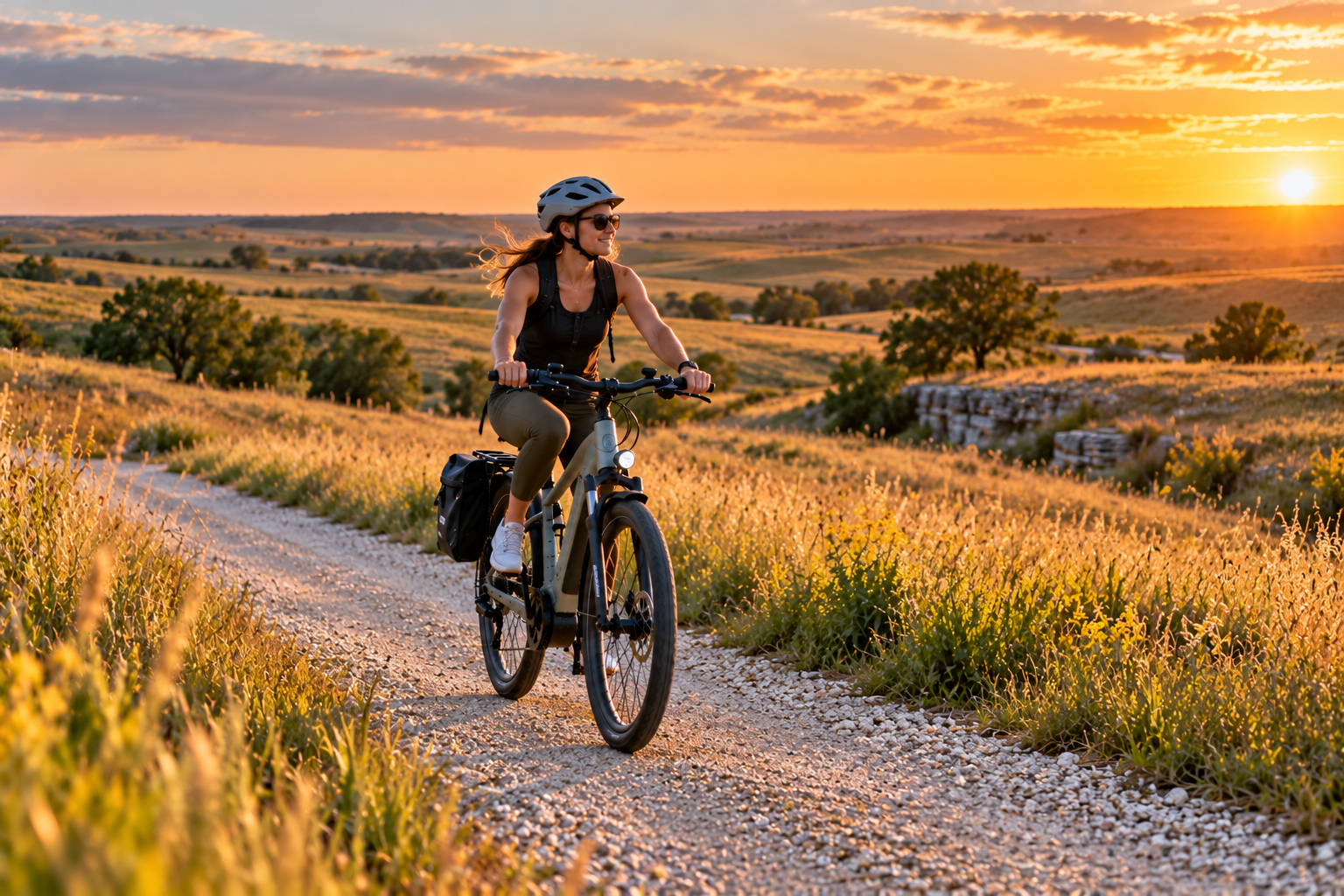
From the Flint Hills to the Wichita suburbs, a legal e-bike rides under the same rules as a pedal bike, and pedal assist takes the sting out of prairie headwinds on rail-trails like the Flint Hills Trail and Prairie Spirit Trail.
State law is only the baseline. Cities can regulate e-bikes on streets and sidewalks, and trail managers can restrict any class on their paths. That matters most for commuters crossing city limits, families buying a teenager’s first e-bike, and visitors from other states.
This guide draws on Kansas statutes and city ordinances reviewed in October 2026. It is general information, not legal advice.
What Is An E-Bike Under Kansas Law?
Under K.S.A. 8-1489, an electric-assisted bicycle has two or three wheels, a saddle, fully operative pedals, and an electric motor of less than 750 watts. It must also fit one of three classes.
A legal e-bike is not a motor vehicle, which separates it from motorized bicycles, mopeds, and motorcycles. The definition is strict. A bike with an 800-watt motor, no working pedals, or a throttle that pushes past 20 mph does not qualify, however it was marketed. Many electric dirt bikes sold as “e-bikes” fail this test.
Use this quick branching check before you buy or ride:
Question 1: Does the frame carry a label showing class, top assisted speed, and motor wattage?
- Yes, or the bike was built before 2023: go to Question 2.
- No, and the bike is newer: ask the seller for written specifications first.
Question 2: Is the motor rated under 750 watts, with working pedals?
- Yes: go to Question 3.
- No: the bike likely is not a legal e-bike. Read the license section before riding on public roads.
Question 3: Where does motor assistance stop?
- At 20 mph: Class 1 or Class 2, with the widest trail access.
- At 28 mph, pedaling only: Class 3. Operators must be 16 or older, and many paths are off limits.
- Somewhere else: treat it as out of class until a shop confirms otherwise.
What Are The Legal Speed And Motor Watt Limits For E-Bikes In Kansas?
The motor must be rated below 750 watts. Assistance must stop at 20 mph for Class 1 and Class 2 and at 28 mph for Class 3.
These are assistance cutoffs, not top speeds; posted limits and city ordinances still apply. Problems usually start with tuning kits, firmware hacks, and swapped controllers. Under K.S.A. 8-1592b(d), nobody may change a bike’s motor-powered speed or engagement unless the class label is replaced to match. If assistance then exceeds 28 mph or the motor reaches 750 watts, relabeling cannot help, because the bike no longer fits any class. Before modifying anything, ask your insurer whether claims stay covered.
Does Kansas Use The Three Class E-Bike System?
Yes. Kansas adopted it through House Substitute for SB 101, effective July 1, 2022.
| Class | How The Motor Works | Assist Stops At | Minimum Operator Age | State Park Trails |
|---|---|---|---|---|
| Class 1 | Pedal assist only | 20 mph | No state minimum | Allowed where bikes are allowed |
| Class 2 | Throttle can propel the bike | 20 mph | No state minimum | Allowed where bikes are allowed |
| Class 3 | Pedal assist only | 28 mph | 16 | Not allowed |
At the state level, a throttle-equipped Class 2 bike is treated like Class 1. Some local trail managers have handled throttle bikes differently, so read posted signs on county and city paths. The official Kansas e-bike statute sets out the rider rules, labeling duty, and trail authority in one place.
Do You Need A License Or Registration To Ride An E-Bike In Kansas?
No. K.S.A. 8-1592b(b) exempts a legal e-bike and its rider from a driver’s license, registration, title, license plate, and liability insurance. There is no annual fee.
The exemption covers only bikes that meet the definition. An electric bike that misses it is typically treated as a motorized bicycle or motorcycle, which bring licensing and registration requirements. Confirm the category with the Kansas Department of Revenue before riding one on public roads.
Voluntary city or campus bike registration for theft recovery is optional but useful. Photograph your receipt, serial number, and class label on purchase day.
What Is The Minimum Age For Riding An E-Bike In Kansas?
You must be at least 16 to operate a Class 3 e-bike. Kansas sets no statewide minimum for Class 1 or Class 2. Riders under 16 may ride as passengers on a Class 3 bike designed to carry them, but not as operators.
Local rules can be stricter. Kansas City, Missouri’s new ordinance sets a minimum operator age of 12 for devices that reach 20 mph, according to local coverage of the July 2026 vote.
Use case (hypothetical): A parent in Olathe wants an e-bike for a 14-year-old’s ride to school. Class 3 is off the table under state law. Class 1 fits, but Olathe requires a helmet under 18, and part of the route uses a paved trail. The practical plan is a Class 1 bike, a certified helmet, and a weekend practice ride on that trail first.
Do You Need Insurance To Ride An E-Bike In Kansas?
No. Kansas does not require insurance for legal e-bikes, but that does not mean you are covered. Some homeowner and renter policies exclude motorized bikes or cap theft coverage below an e-bike’s price. Ask your agent:
- Does my policy treat an e-bike as a bicycle or a motorized vehicle?
- Is theft covered away from home?
- Is fire damage from a charging battery covered?
- Am I covered if I injure a pedestrian or damage a car?
If the answers leave gaps, price a standalone bicycle policy.
Do You Need A Helmet To Ride An E-Bike In Kansas?
No statewide law requires a helmet for e-bike riders of any age in Kansas.
A 2026 bill, HB 2459, would have required helmets for riders 17 and under on e-bikes and electric scooters. It died in the House Transportation Committee, though lawmakers may revisit the idea in 2027.
Olathe, Leawood, Fairway, Prairie Village, and Kansas City, Missouri require helmets under 18. Look for a CPSC certification label inside the shell, fit it level just above your eyebrows, and replace it after any crash.
What Equipment And Labeling Must An E-Bike Carry In Kansas?
Every e-bike needs a brake that can skid the braked wheels on dry, level, clean pavement. Between sunset and sunrise, you also need lights.
The bicycle lighting statute, K.S.A. 8-1592, requires a white front lamp visible from at least 500 feet. On the rear, you need a red reflector, a red lamp visible from 500 feet, or a worn device emitting red or amber light visible from 500 feet. E-bikes must also meet federal bicycle standards in 16 C.F.R. Part 1512.
Since January 1, 2023, manufacturers and distributors must permanently attach a prominent label showing the class number, top assisted speed, and motor wattage, in Arial at nine-point size or larger.
Use this checklist when inspecting a new or used bike:
| Check | What To Look For | If It Fails |
|---|---|---|
| Class label | Class, top assisted speed, and wattage | Get written specifications from the seller |
| Brakes | Wheels skid on dry, clean pavement | Adjust or replace before riding |
| Front light | White, visible from 500 feet | Add a rechargeable headlight |
| Rear visibility | Red reflector, red light, or worn red or amber light | Add a rear light |
| Pedals | Fully operative, with reflectors | The bike may not qualify |
If an online purchase arrives unlabeled and the seller will not provide specifications, consider a return or a complaint to the Kansas Attorney General.
Where Can You Legally Ride An Electric Bicycle In Kansas?
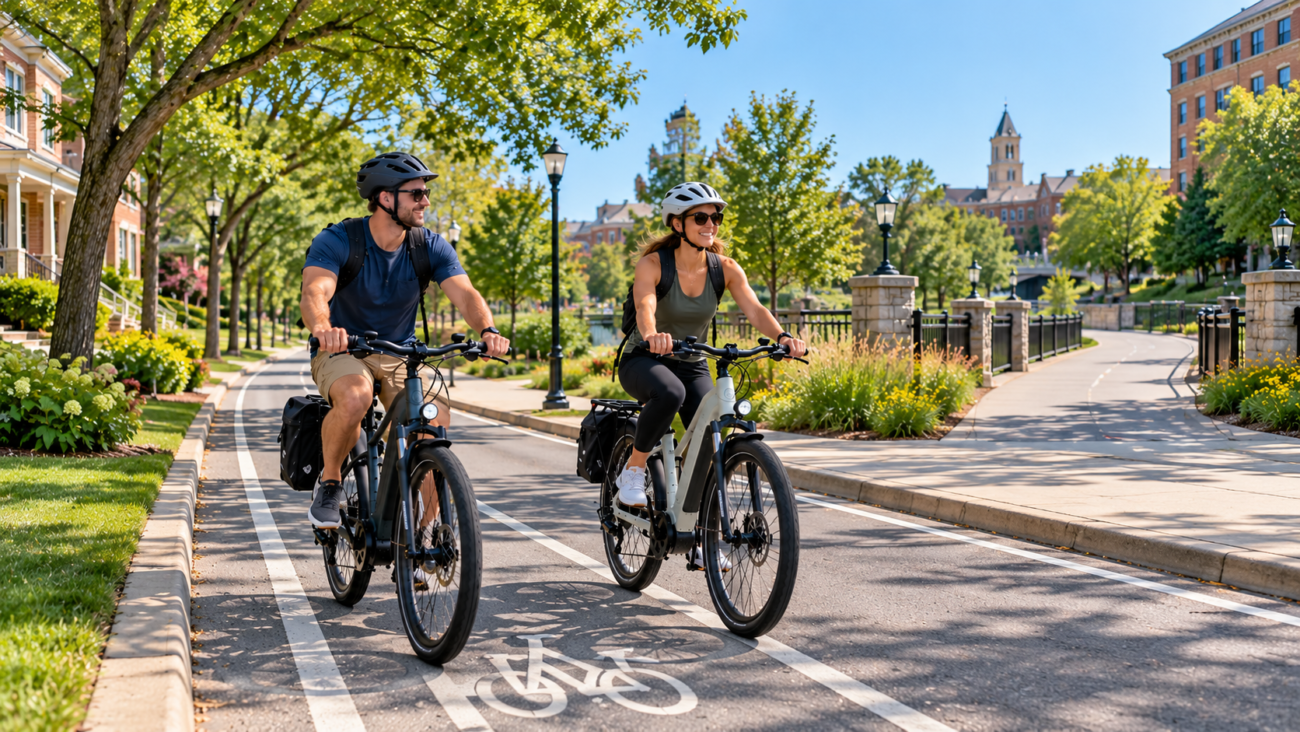
You can ride a legal e-bike anywhere a regular bicycle is allowed, including streets, highways, bike lanes, and multi-use paths, unless a city or trail manager restricts it. Interstates are off limits to all bicycles in Kansas.
Where a usable bike path runs alongside a roadway, Kansas law directs bicyclists to use it, and drivers must leave at least three feet when passing. Sidewalk riding is a local decision.
| Location | Class 1 And 2 | Class 3 |
|---|---|---|
| Streets, roads, and bike lanes | Allowed | Allowed |
| Multi-use paths | Allowed unless restricted | Allowed by default, often restricted locally |
| State park trails open to bikes | Allowed | Not allowed |
| Natural-surface nonmotorized trails | Managing agency decides | Managing agency decides |
| National grasslands | Motorized routes only | Motorized routes only |
| Interstates | Not allowed | Not allowed |
Are E-Bikes Allowed On Trails And Bike Paths In Kansas?
Usually, yes, but the trail manager has the final word. State law lets e-bikes use paths and trails by default, and any city, county, or state agency managing a path may restrict all e-bikes or one class.
Natural-surface trails are the exception. On a trail designated nonmotorized with a native-soil tread, the default right does not apply, and the agency decides whether e-bikes are welcome.
On crushed-limestone rail-trails, slow near walkers and horses, call out before passing, and check the managing agency’s rules and any trail pass before a long ride.
Where Can You Ride A Class 3 E-Bike In Kansas?
Class 3 bikes are welcome on streets, roads, and bike lanes statewide. They are excluded from state park trails and often restricted on local multi-use paths, because a 28 mph bike beside strollers creates a large speed gap.
A posted Class 3 ban generally applies to the bike itself, so lowering the assist level is not a reliable workaround, and ignoring it can bring a local citation.
Can You Use E-Bikes On Public Land In Kansas?
Yes, with limits that depend on the agency. Kansas state parks allow e-bikes whose assistance stops at 20 mph on trails already open to bicycles.
Federal land differs. The Forest Service e-bike policy treats e-bikes as motor vehicles, so on the Cimarron National Grassland they are limited to routes open to motorized use. Many Kansas reservoirs sit on U.S. Army Corps of Engineers land, where rules vary by project, so call the lake office first.
Before loading the rack, confirm the managing agency, whether your class is allowed, any pass or fee, and any seasonal, hunting, or wet-weather closures.
What Are The E-Bike Rules In Kansas City?
Kansas City sits in two states, so the rules change at State Line Road. Kansas law governs Kansas City, Kansas and Johnson County; Missouri law governs Kansas City, Missouri.
Kansas City, Missouri passed Ordinance 260508 on July 30, 2026. It takes effect after a 120-day education period ending in late November 2026, and a first violation draws a warning.
| Rule | Kansas City, Missouri | Kansas Side Of The Metro |
|---|---|---|
| Governing law | Missouri law plus Ordinance 260508 | Kansas law plus each city’s code |
| Class 3 operator age | 16 | 16 under state law |
| Helmets | Required under 18 | Required under 18 in several cities |
| Sidewalk speed | 15 mph, none in business districts | Set by each city, often 15 mph |
| Bike lanes and trails | 20 mph limit | Set by each city or trail manager |
Overland Park, Olathe, Leawood, Shawnee, Prairie Village, and Fairway each have their own e-bike ordinances. For Kansas City, Kansas, check the Unified Government of Wyandotte County code. This KCMO ordinance summary from BikeWalkKC explains what changed and where advocates still disagree.
Use case (hypothetical): A Johnson County rider commutes on a Class 3 e-bike to Kansas City, Missouri. On the Kansas side, streets are fine but some paths may be closed to Class 3. Across State Line Road, Missouri bike lanes carry a 20 mph limit once enforcement begins. A street-based route and a steady 20 mph pace in Missouri bike lanes keep the commute compliant.
Where Can You Rent An Electric Bike In Kansas City?
The easiest option is RideKC Bike, run by the nonprofit BikeWalkKC. It offers Class 1 pedal-assist bikes through the RideKC Bike app, with hubs in both Kansas Cities, Lenexa, and Overland Park.
Pricing varies: Lenexa lists $1 to unlock plus 10 cents per minute, Overland Park $1 plus 25 cents. Some cities store the bikes from December through February, so check the app before a winter ride.
For longer rentals, call local bike shops, and check battery charge, brakes, and saddle height at pickup. A few hours on a share bike also shows how much assist you need before buying.
Frequently Asked Questions About Ebikes In Kansas
Are Ebikes In Kansas Legal To Ride Without A License?
Yes. Kansas excludes legal electric-assisted bicycles from the motor vehicle definition, so you need no driver’s license, registration, or insurance. The bike must have working pedals, a motor under 750 watts, and fit Class 1, 2, or 3. Class 3 operators must be 16 or older.
Do You Need A Helmet To Ride An E-Bike In Kansas?
Kansas has no statewide helmet law for e-bike riders. Several cities, including Kansas City, Missouri, Olathe, and Leawood, require helmets for riders under 18, so check local rules. A CPSC-certified helmet is a smart choice for every rider.


