
Blog
Ebikes In Ohio (A Complete Rider Guide To Laws, Trails And Buying)
Just bought an e-bike and wondering whether you can take it on the Olentangy Trail this weekend? Ebikes in Ohio are legal statewide and treated much like regular bicycles, but only when the bike fits the state’s three-class system: working pedals, a motor under 750 watts, and a manufacturer’s class label. Miss one of those, or ride where a park district posts stricter rules, and a relaxed ride can end with a citation. This guide covers the definition, the riding rules, the 2026 city ordinances that caught a lot of riders out, and smart buying.
Key Takeaways
- Ohio sorts e-bikes into Class 1, 2, and 3 under Ohio Revised Code 4511.522, and every class needs working pedals and a motor of less than 750 watts.
- No driver’s license, registration, or insurance is required for any class.
- Class 3 operators must be 16 or older, and everyone aboard a Class 3 bike must wear a CPSC or ASTM helmet at any age.
- Class 1 and 2 bikes may use shared-use paths unless the managing authority bans them. Class 3 bikes may use only paths beside a highway or paths that expressly allow them.
- Natural-surface trails stay closed to all classes unless the land manager opens them. In state parks, only Class 1 is allowed on natural surface and mountain bike trails.
- Sidewalk riding is legal under state law only with the motor off, and Independence, Mentor, Parma and North Baltimore all tightened their rules in 2026.
- Penalties escalate: a minor misdemeanor becomes a fourth or third-degree misdemeanor with prior traffic convictions in the same year.
Table of Contents
Ready to compare models? Browse our e-bike inventory, where every listing shows the class, motor rating, and assisted top speed so you can check Ohio compliance before you order. Contact our team or text (714) 749-3162 to spec a custom build and confirm delivery to your Ohio ZIP code. Financing is available with $800 down, no credit check, and no interest.
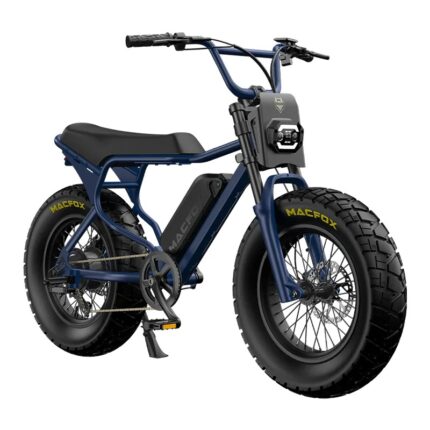
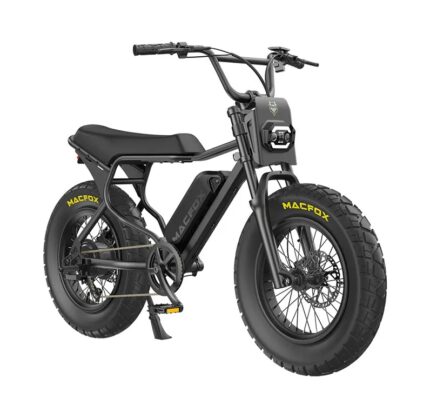
Ebikes In Ohio
Ohio’s electric bicycle rules sit mainly in one statute, Ohio Revised Code 4511.522. House Bill 250 created it, effective March 8, 2019, and House Bill 295 amended it, effective April 15, 2021. It decides where you ride, how fast the motor helps, and who wears a helmet.
Under Ohio traffic law the definitions do a lot of quiet work in your favor. A compliant e-bike is included in the definition of “bicycle,” it is a vehicle, and it is expressly excluded from both “motor vehicle” and “motorized bicycle.” You follow the same road rules as a cyclist without the paperwork a car or a moped requires.
Remove the label, fit a bigger motor, or unlock the limiter, and that protection can disappear.
How Does Ohio Define An Electric Bike?
Ohio defines an electric bicycle as a bicycle with fully operable pedals and an electric motor of less than 750 watts that fits one of three classes. The statute says “less than seven hundred fifty watts,” so a motor rated at exactly 750 does not qualify.
Section 4511.522 adds two requirements. Since January 1, 2020, manufacturers and distributors must permanently affix a label in a prominent location showing the class, the top assisted speed, and the motor wattage. Manufacturers must also build the bike to meet the federal bicycle equipment requirements in 16 C.F.R. 1512.
| Vehicle | Pedals | Typical Power | How Ohio Treats It |
|---|---|---|---|
| Electric bicycle (Class 1–3) | Fully operable | Electric, under 750W | Bicycle rules, no license |
| Motorized bicycle (moped) | Varies | Up to 50cc, one brake horsepower | Separate license and equipment rules |
| Stand-up electric scooter | No | Electric | Low-speed micromobility rules |
| E-moto or electric dirt bike | Often none | High-output electric | Motor vehicle or off-road rules |
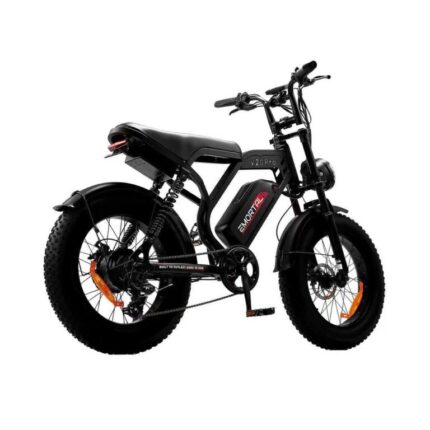
Buyer beware: some e-motos ship with decorative pedals. If they cannot realistically propel the bike, it will not pass as a bicycle, and no sticker changes that.
How Fast Can An Ebike Go Legally In Ohio?
The motor must stop assisting at 20 mph on Class 1 and Class 2 bikes and at 28 mph on Class 3 bikes. Past those speeds the bike can keep rolling on leg power or gravity alone.
Ohio limits motor-assisted speed, not total speed. A strong rider descending a hill on a Class 1 bike can legally pass 20 mph once the motor has cut out.
Posted limits still win, and on busy trails they are well below the class cutoffs. Mill Creek MetroParks near Youngstown allows Class 1 and Class 2 e-bikes on its Bikeway, bars Class 3 from the park, and holds every user to 15 mph. Cuyahoga Valley National Park also posts a speed limit on the Towpath Trail, so read the signs rather than assuming your class cutoff is the ceiling.
What Are The Three Classes Of E-Bikes In Ohio?
| Class | How Power Works | Assist Cutoff | Extra Ohio Rules |
|---|---|---|---|
| Class 1 | Pedal-assist only | 20 mph | Widest path and trail access |
| Class 2 | Throttle or pedal-assist | 20 mph | Motor must cut out when you brake or release the switch |
| Class 3 | Pedal-assist only | 28 mph | Speedometer required, operator 16 or older, helmet for everyone aboard |
To confirm the class before you pay, find the label on the frame, usually near the bottom bracket, seat tube, or down tube, and compare it with the spec sheet. No label is a reason to walk away. How the three-class system works nationally is worth a read if you ride across state lines, because Ohio tracks the national model closely but not perfectly.
Are Electric Bikes Legal In Ohio?
Yes. Electric bicycles are legal across Ohio when they meet the statute’s equipment and power limits. Legality depends on the machine, not the price: a labeled 500W budget bike qualifies, while a 1,500W premium build does not.
Cities keep real authority, and several used it in 2026. Independence barred Class 3 e-bikes from every sidewalk at any time in July and now requires a helmet for anyone under 18 on any class, operator or passenger. Mentor passed three ordinances on September 15, 2026, effective immediately: a helmet for every operator of every class, an audible warning before passing a pedestrian, and passengers only on bikes the manufacturer built to carry them. Parma’s ordinance 373.21 requires helmets for all riders and passengers, plus a white front light, a red rear light and a reflector from sunset to sunrise. North Baltimore banned e-bikes and similar devices from village sidewalks entirely, effective September 17, 2026.
Statewide changes are under discussion and none of them are law. House Bill 948, introduced in June 2026 by Representatives Andrea White and Kevin Miller, is an education bill: a public awareness campaign, road-sharing content in driver education and the driver exam, and an ODOT leaflet that retailers, including online sellers, would hand to buyers. Senate Bill 477, from Senator Bill DeMora, goes much further, proposing to bar operators 13 and younger, require helmets, register personal e-bikes with the state for $25 with impoundment for failure to register, and cap speeds at 10 mph on shared-use paths and 5 mph on sidewalks. As of November 2026 neither has passed, and Ohio’s two-year session ends in December, so anything that does not pass must be reintroduced.
Do You Need A License To Ride An E-Bike In Ohio?
No. Ohio requires no driver’s license, registration, or insurance for any e-bike class.
Mopeds are different. A motorized bicycle is a separate category, generally requiring a license, registration, specific equipment, and a helmet for riders under 18. Because the statute excludes electric bicycles from the moped definition, a compliant e-bike never falls into that bucket.
No license does not mean no duties. You must obey signals, stop signs, and lane rules like any cyclist, riding impaired can bring an OVI charge, and freeways are off-limits.
Expert tip: one Ohio rule is written to help you by name. Under ORC 4511.132, a signal counts as malfunctioning when its vehicle detector fails to detect a bicycle or an electric bicycle. You then stop at the stop line or before the crosswalk, yield to anything in or approaching the intersection that would be an immediate hazard, and proceed with ordinary care. Light e-bikes miss pavement loop sensors often, and unlike several neighboring states, Ohio names e-bikes in the statute rather than leaving it to inference.
What E-Bikes Are Illegal In Ohio?
An e-bike falls outside Ohio law when it no longer fits the three-class definition. The common reasons:
- No fully operable pedals
- A motor rated at 750 watts or more
- Motor assist above 20 mph on Class 1 and 2, or above 28 mph on Class 3
- No class label, or a label that does not match the bike
Modification is the biggest trap, and the statute addresses it directly: no one may alter an e-bike’s top assisted speed unless the label is updated to match. An unlocked Class 2 bike that now assists to 30 mph fits no class at all and could be handled as a moped or a motor vehicle, with licensing and registration consequences on top of the citation.
The penalties are worth knowing because they escalate. Riding where your class is prohibited, or breaking the Class 3 age or helmet rules, is a minor misdemeanor. With one prior motor vehicle or traffic conviction in the previous year it becomes a fourth-degree misdemeanor, and with two or more it becomes a third-degree misdemeanor. These are strict liability offenses, meaning the state does not have to prove you meant to break the rule. If you are cited, speak with an Ohio traffic attorney.
Do You Have To Wear A Helmet On An E-Bike In Ohio?
It depends on the class and the city. State law requires every operator and passenger on a Class 3 e-bike to wear a protective helmet meeting Consumer Product Safety Commission or ASTM standards, at any age. There is no statewide helmet rule for Class 1 or Class 2.
Cities have filled that gap fast. Mentor and Parma require helmets on every class, and Independence requires one for every rider under 18. If your route crosses municipal lines, the strictest rule on the route is the one to plan around.
Even where it is optional, wear one. A 60-pound e-bike at 20 mph carries far more energy than a road bike at the same speed and needs more distance to stop.
How Old Do You Have To Be To Ride A Class 3 E-Bike In Ohio?
You must be at least 16 to operate a Class 3 e-bike. A rider under 16 may ride as a passenger, but only on a Class 3 bike designed to carry passengers, and that passenger needs a helmet too.
Ohio bicycle law also allows child seats and child trailers, provided they are firmly attached. For teens and family rides, Class 1 is usually the practical choice: no state age limit and the widest path access.
What Is The Maximum Motor Power For A Legal E-Bike In Ohio?
The motor must be less than 750 watts, and the label must state the wattage. The statute does not say whether that means rated continuous output or peak output, so the label is your best reference point.
Sellers often advertise peak wattage, the brief surge a motor produces under load. A “1,200W peak” listing may describe a motor rated at 750W or less, or one rated far above it. Ask for the rated figure in writing and match it to the frame label.
Dual-motor builds sit in a genuine grey area, since the statute speaks of “an electric motor” in the singular and never addresses two. Treat a dual-motor bike as a compliance risk rather than a settled question.
Where Can You Ride An E-Bike In Ohio?
All three classes may use public roads and bike lanes wherever bicycles are allowed. Paths and trails depend on your class and on who manages the ground.
| Location | Class 1 | Class 2 | Class 3 |
|---|---|---|---|
| Roads and bike lanes | Yes | Yes | Yes |
| Bike-only and shared-use paths | Yes, unless banned locally | Yes, unless banned locally | Only beside a highway, or if authorized |
| ODNR paved and gravel bike trails | Yes, unless posted | Yes, unless posted | No |
| ODNR natural surface and mountain bike trails | Yes | No | No |
| ODNR roads | Yes | Yes | Yes |
| Other natural-surface trails | Only if opened | Only if opened | Only if opened |
| Sidewalks | Motor off, city may ban | Motor off, city may ban | Motor off, city may ban |
| Freeways | No | No | No |
Section 4511.522(C) is the reason that table has so many conditions. It grants Class 1 and Class 2 access to bike-exclusive and shared-use paths unless the controlling authority prohibits them by resolution, ordinance, or rule; it keeps Class 3 off those paths unless the path runs within or adjacent to a highway or the authority authorizes it; and it closes mountain biking, hiking, equestrian, and historically nonmotorized single-track to all three classes unless the authority opens them.
Use case: the Columbus commuter. A rider wants a Class 3 bike for a 12-mile commute that includes part of the Olentangy Trail. Because that is a shared-use path, a Class 3 bike is allowed only where it runs beside a road or where Columbus Recreation and Parks permits it. The practical move is a road-based route with bike lanes, or a Class 1 bike if the trail itself is the main draw. The limit of this advice: path designations change, so confirm with the managing agency before committing to a daily route.
Can You Ride An E-Bike On Bike Trails And ODNR Land In Ohio?
Usually on paved trails, rarely on dirt, and the pattern is the opposite of what most riders expect. Under current ODNR rules, Class 1 and Class 2 bikes may use paved or gravel trails built to accommodate bicycles unless signs say otherwise. On natural surface and mountain bike trails where bicycles are permitted, only Class 1 is allowed. Class 3 bikes are confined to ODNR roads, where all three classes are welcome. E-bikes are barred entirely from Scioto Trail State Forest and from any trail closed to bicycles.
Rail-trails and towpaths answer to different managers. Cuyahoga Valley National Park allows Class 1 and Class 2 on the Towpath Trail and anywhere traditional bicycles are allowed, and permits Class 1 on the East Rim mountain bike trails. Confirm current rules before you go, because these policies have moved more than once.
Can You Ride An E-Bike On The Sidewalk In Ohio?
Only with the motor off. The sidewalk statute bars vehicles from sidewalks and carves out bicycles, but for an electric bicycle the carve-out applies only when the motor is not engaged. Ride the sidewalk under your own legs and you are fine; ride it under power and you are in the ban.
Local governments may regulate sidewalk riding further, and the 2026 ordinances show them doing it. One limit cuts the other way and is worth knowing: no local authority in Ohio may require that bicycles or electric bicycles be operated on sidewalks.
Where sidewalk riding is allowed, keep it to walking pace and yield to pedestrians.
What Should Ohio Riders Check Before Every Ride?
A pre-ride check takes about two minutes, and Ohio’s equipment statute sets most of it for you:
- From sunset to sunrise, run a white front lamp visible 500 feet ahead and 300 feet to the sides. It may be mounted on the bike or on you.
- Carry a red rear reflector visible from 100 to 600 feet behind, and a flashing or steady red rear lamp visible from 500 feet. A red lamp that meets the reflector standard can serve as both.
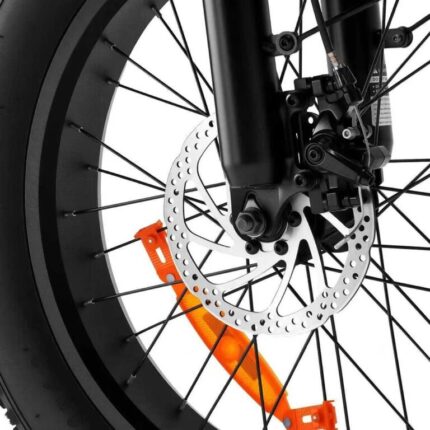
- Squeeze both brakes. Ohio requires an adequate brake on any street or highway.
- Check tire pressure against the range printed on the sidewall.
- Confirm the battery covers the round trip with a buffer for wind and hills.
- Carry ID and a phone in case of a breakdown or a crash.
If a mechanic has not looked at your brakes this season, book a tune-up before the next long ride.
Where Can You Buy Or Custom Build An E-Bike In Columbus And Across Ohio?
Start with a test ride, and ride at least two classes back to back. A throttle feels nothing like pedal-assist, and a heavier bike changes how you corner and stop. Our e-bike buying guide covers frames, batteries, and motors in more depth.
A custom build lets you choose frame size, gearing for Ohio’s hills, cargo racks for groceries or kids, and battery capacity sized to your real daily distance. Whatever you build, the finished bike needs a class label that matches its actual motor and speed settings.
| Buying Option | Best For | Watch Out For |
|---|---|---|
| New from a shop | First-time buyers | Higher upfront price |
| Custom build | Specific fit or cargo needs | Correct label and class |
| Pre-owned | Budget shoppers | Battery age, warranty transfer limits |
| Online direct import | Experienced riders | Missing labels, no local support, uncertified batteries |
Battery safety deserves its own check. Ask whether the electrical system is certified to UL 2849 or the battery to UL 2271. The Consumer Product Safety Commission proposed a mandatory lithium-ion battery standard for micromobility products in June 2026, having found the existing voluntary standards inadequate, but that rule is not final, so certification is still the buyer’s job. With used bikes, ask for the battery’s age and confirm whether the warranty transfers.
Use case: the Holmes County family. Parents want one bike for school runs and weekend trail rides with two young children. A Class 1 cargo bike with a firmly attached child seat or trailer fits state law, avoids the Class 3 age limit and path restrictions, and keeps the most trails open, including ODNR natural surface trails where Class 2 is barred. The trade-off is no throttle to help from a standstill with a loaded bike.
Quick quiz: which class fits you?
Question 1: Will you ride natural surface or mountain bike trails in Ohio state parks?
- Yes: see Result A. Class 1 is the only class allowed there.
- No: go to Question 2.
Question 2: Do you need a throttle for starts, hills, or heavy loads?
- Yes: see Result B.
- No: go to Question 3.
Question 3: Are you 16 or older and riding mostly on roads?
- Yes: see Result C.
- No: see Result A.
- Result A: Class 1, for the widest path and trail access in Ohio.
- Result B: Class 2, accepting that ODNR natural surface trails are closed to it.
- Result C: Class 3, accepting the helmet rule for everyone aboard and the shared-use path limits.
This quiz is a starting point, not legal advice, and a single city ordinance on your route can change the answer.
Frequently Asked Questions About Ebikes In Ohio
What Are The Rules For E-Bikes In Ohio?
Ohio e-bikes need fully operable pedals, a motor of less than 750 watts, and a class label. Class 1 and 2 bikes assist to 20 mph and Class 3 bikes to 28 mph. Class 3 operators must be 16 or older, and everyone aboard must wear a helmet. No license or registration is needed.
Can You Ride An E-Bike On The Road In Ohio?
Yes. All three classes may ride on Ohio roads and bike lanes wherever bicycles are allowed, except freeways. Riders follow the same traffic laws as cyclists, including signals, stop signs, and the lamp and reflector rules from sunset to sunrise.


